

Make / Model Search
Future models - PorschePorsche plots three-model ICE SUV fightbackThree new combustion SUVs loom as Macan volume falls in Australia on EV transition29 May 2026 By TOM BAKER in GERMANY A DECISION by Porsche to amend its former electric-only SUV model strategy in favour of developing three new combustion-powered crossovers for launch this decade will boost the German brand’s fortunes in markets that have cooled on EVs, but powertrain agnosticism will also be relevant in Australia.
The performance car marque is preparing a new Macan-sized petrol and hybrid-powered SUV, a fresh generation for the combustion version of the Cayenne, and a larger three-row flagship SUV as part of a broader move away from its previous plan to push key model lines towards full electrification.
Bullish predictions for growing EV uptake in key markets spurred Porsche to push its Macan and Cayenne SUVs away from combustion engines and towards full electrification in their latest generations.
The transition was completed for the Macan in Australia, with the EV version replacing the discontinued combustion SUV from December 2024. While the Macan Electric has found some success locally, Porsche delivered just 2194 Macan units in 2025, down from 3323 the year before.
While the Macan remained easily the best-selling model for Porsche Cars Australia (PCA), the result accounted for a 27 per cent slip in total sales in 2025.
PCA is understood to have planned for a decline in Macan demand due to the powertrain transition.
Similar results in other markets fed into a decision by Porsche headquarters not to cease production of combustion versions of the now eight-year-old, fourth-generation Cayenne, which will remain in showrooms even after the arrival of the Cayenne Electric in Australia later in 2026.
Plugging the Macan sales gap is a priority for Porsche, and the company is now preparing a new compact SUV model that will harness the Volkswagen Group’s Premium Platform Combustion (PPC) architecture that sits beneath the new Audi Q5 and SQ5 models.
Porsche chief executive Oliver Blume told investors last year that the petrol and hybrid SUV will be available globally “not later than 2028”, but insiders suggest that it may not use the Macan name, which has been transferred to the EV.
The renewed combustion push won’t stop there, as Porsche is working on a fifth-generation petrol and plug-in hybrid (PHEV) Cayenne model that will continue to offer V6 and V8 powertrains to sit alongside the battery-electric Cayenne model.
Speaking with GoAuto at the international launch of the Cayenne Electric, Porsche product spokesperson Ben Weinberger said that the brand would continue to sell a combustion Cayenne “way far into the next decade”.
“We are talking about 2030-something where we will definitely offer both (ICE and EV). It will not be the car we have now for the next 10 years,” said Mr Weinberger.
While Porsche SUV drive systems manager Dr Timo Henn reflected that the Cayenne Electric offered distinct advantages in motor response, torque, and high-tech chassis systems, he acknowledged that the combustion Cayenne served different buyer tastes.
“You have (with ICE) a car which is maybe more mechanical feeling … you can have a V8 engine, which is maybe important to some customers,” said Dr Henn.
The third SUV in Porsche’s revised strategy will be larger. Known internally as the K1, this model will sit above the Cayenne and enter the upper-large luxury SUV segment with petrol or PHEV powertrains and three rows, likely with six- and seven-seat configurations.
Mr Weinberger acknowledged the demand for a three-row Porsche SUV while confirming the Cayenne would not get a seven-seat option.
“For the future, there might be something coming up, it’s going to happen, but definitely not in (the Cayenne),” he added.
Set to sit atop a stretched version of PPC, the K1’s likely opportunity is illustrated by BMW Australia’s success with the upper-large X7.
While the Cayenne-sized BMW X5 remained the dominant large SUV seller for the Bavarian brand, with 3673 deliveries in 2025, the three-row X7 recorded 1125 additional sales; Porsche is leaving untapped potential on the table.
Audi is preparing to enter the same segment with its new Q9 model, which is under close evaluation for Australia as a larger sibling to the Q7.
The Porsche K1 is expected to share some components with the Q9, potentially including an available V8 engine, though a return to diesel power is not expected. 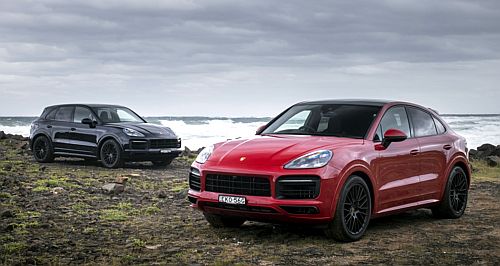 Read moreAll future modelsMotor industry news GoAutoNews is Australia’s number one automotive industry journal covering the latest news, future and new model releases, market trends, industry personnel movements, and international events. |
Click to sharePorsche modelsResearch Porsche All future modelsMotor industry newsGoAutoNews is Australia’s number one automotive industry journal covering the latest news, future and new model releases, market trends, industry personnel movements, and international events. |


 Alfa Romeo
 Abarth
 Audi
Audi Aston Martin
 BMW
BMW Bentley
 Ferrari
 Chevrolet
 Ford
Ford Fiat
Fiat GWM
GWM Foton
Foton Hyundai
 Honda
Honda Jaguar
 Isuzu
Isuzu Kia
Kia Jeep
Jeep Land Rover
 Lamborghini
 Maserati
 Lexus
Lexus McLaren
 Mazda
Mazda MG
MG Mercedes-Benz
 Mitsubishi
 Mini
Mini Peugeot
 Nissan
 Ram
Ram Porsche
 Rolls-Royce
 Smart
Smart Skoda
Skoda Suzuki
 Subaru
 Toyota
 Tesla
Tesla Volvo
Volvo Volkswagen
 Zeekr
Zeekr

Connect with us


Facebook Twitter Instagram